Sometimes things just need to be quick. No five reels, no paytable with thirty rows, no free spins round to wait an hour for. For exactly those moments, EgoGames has a dedicated area: the Mini Games.
Mini Games are compact games with a single, easy-to-understand mechanic. Uncover a tile, cash out at the right moment, drop a ball, call a card higher or lower. The rules are explained in seconds, and a round is often over just as quickly. That is exactly why we have given the Mini Games their own tab in our lobby and explain in detail on this page how the typical game types work, which settings exist and what to watch out for in quick rounds.
The Mini Games area is part of our games overview and can be reached directly via the dropdown in the navigation. Our offer is aimed exclusively at adults aged 18 and over.
How Mini Games differ from slots
At first sight, Mini Games look like the little siblings of slots. In fact, they work differently in many ways, and knowing the differences makes for more conscious play.
| Feature | Classic slot | Mini Game |
|---|---|---|
| Game principle | reels, lines or ways to win | a single mechanic |
| Rules | often extensive, many special features | usually explained in a few sentences |
| Decisions | choose a stake, spin | often own decisions during the round, such as cashing out |
| Round length | a few seconds per spin, longer bonus rounds | often just seconds |
| Settings | stake, sometimes Bonus Buy | risk level, auto cash-out, autoplay |
| Look | elaborate themes and animations | stripped back, clear, functional |
The most important difference lies in the decisions. In many Mini Games, the player decides when a round ends, for example in crash games or when uncovering tiles. That feels like more control. But we say it openly: the decision influences how much risk is taken, not the chance behind it. The outcome of every round remains random.
Typical game types in our Mini Games area
Mini Games come in many variants. The following game types are among the typical concepts players come across in this area. The lobby itself shows which titles are currently in the tab, because the selection changes regularly.

Mines
The principle is as simple as it is exciting: a grid of hidden tiles, with a mine under some of them. With every safe tile uncovered, the multiplier rises. After each tile, the player decides whether to carry on or take the current win. Hitting a mine means losing the stake for that round.
The key setting is the number of mines. Few mines mean many safe tiles and small multiplier steps. Many mines mean few safe tiles, but big jumps in the multiplier. It is a nice example of how Mini Games make risk visible: choosing the number of mines is nothing other than choosing the volatility.
Our impression from many conversations: mines games tempt players to uncover "just one more tile". Deciding beforehand after how many tiles to cash out makes for a much more relaxed game.
Crash
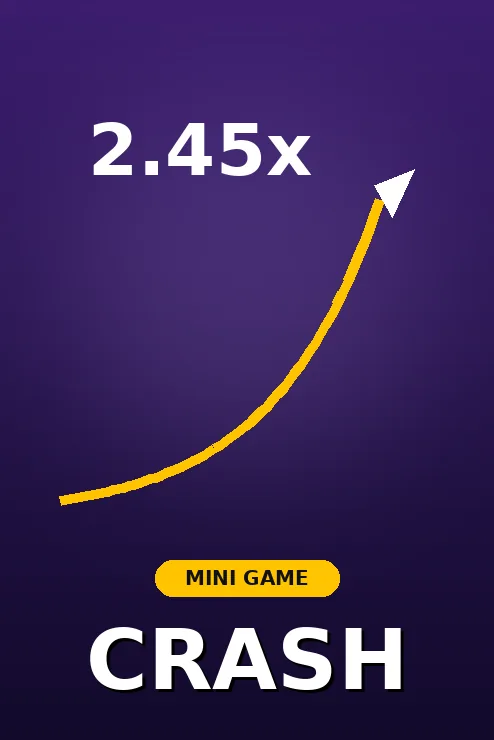
In crash games, a multiplier starts at 1.00x and keeps rising, often shown as a curve, a plane or a rocket. At a random moment the round "crashes". Anyone who cashed out before then receives the stake multiplied by the value at the moment of cashing out. Anyone still in loses the stake.
Crash games live from that one moment of decision. Some rounds end at 1.0x, others run well into three figures. Many variants allow an automatic cash-out at a multiplier set in advance, and often two stakes can be played in parallel with different cash-out points.
One point we like to make clear: there is no rhythm that crash rounds follow. A series of low results does not make a high result in the next round more likely. Every round is independent.
Plinko
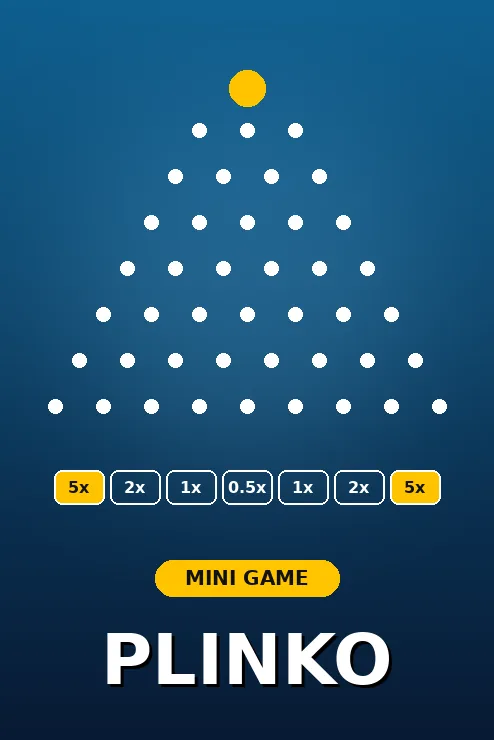
A ball drops from the top through a field of pegs, bouncing left or right along the way. At the bottom it lands in one of several slots, each with its own multiplier. The slots in the middle usually have low values and the outer ones high values, because the ball lands there less often.
Plinko often has two settings: the number of rows and the risk level. More rows mean more slots and a bigger spread between low and high values. A higher risk level shifts the distribution so that the middle slots pay less and the outer ones more. Visually, Plinko is one of the most relaxing Mini Games, and precisely because of that, rounds here often go faster than one realises.
Dice
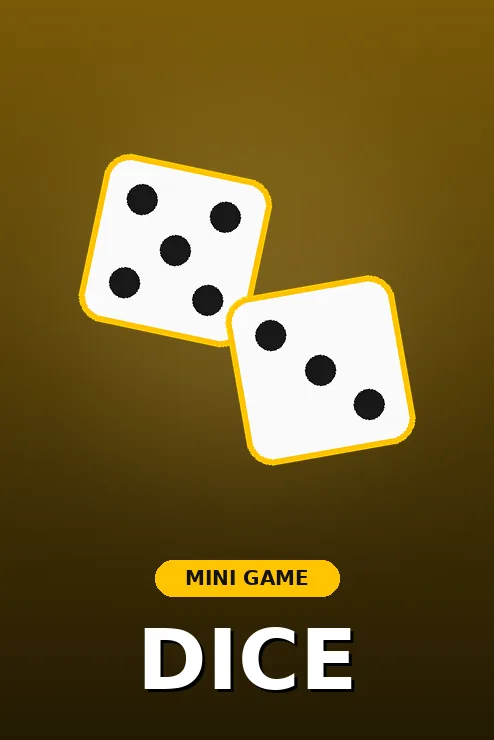
Dice games in Mini Game form usually work with a number range. The player sets a threshold and predicts whether the result will land above or below it. The lower the probability of the chosen range, the higher the multiplier.
The nice thing about dice games is their transparency. The link between probability and possible win is directly visible. Choosing a range with a high probability means winning often but little. Choosing a narrow range means winning rarely but a lot.
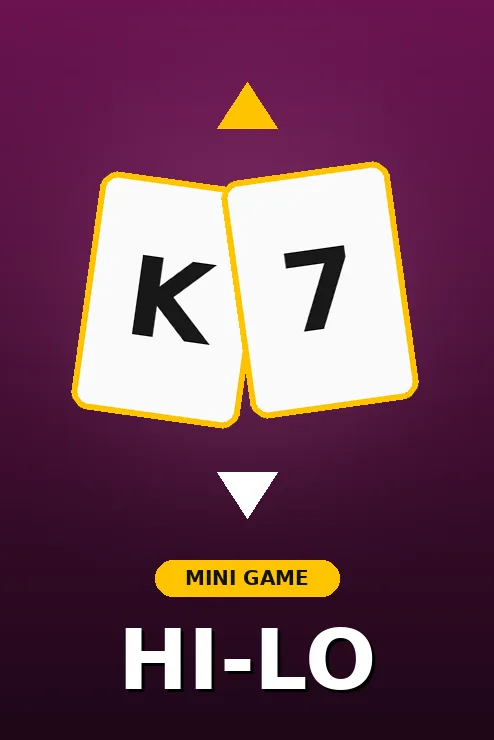
Hi-Lo
One card is face up, and the question is simple: will the next card be higher or lower? With every correct call the multiplier rises, and the player decides whether to carry on or take the win. The clearer the starting position, for example with a very low or very high card, the lower the multiplier for the obvious call.
Hi-Lo feels familiar because many people know the principle from card games. It is a good example of a Mini Game in which every decision is made consciously rather than the round simply running through.
Limbo
Limbo is essentially crash without the wait. Before the round, a target multiplier is set. Then a random result is generated. If it is above the target, the stake wins at the target multiplier; if it is below, the stake is lost. A round lasts just an instant.
It is exactly this speed that makes Limbo the game where we point out the pace most clearly. A hundred rounds are played within a few minutes, especially with autoplay.
Tower games
In tower games, players climb level by level. On each level there are several tiles, one or more of which are safe. Choosing the right tile moves the player up a level and the multiplier grows. Choosing wrong means losing the stake. It is possible to cash out after every level.
As with mines, the difficulty can be adjusted, usually via the number of safe tiles per level. Easy levels bring many small steps, hard levels a few big ones.
Keno-style games
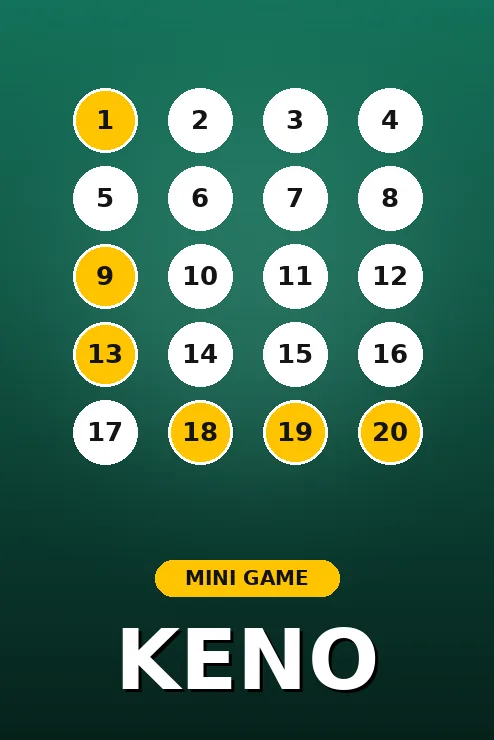
A few numbers are chosen from a field, after which random numbers are drawn. The more hits, the higher the win according to a fixed table. Keno-style Mini Games are usually faster than classic keno and often have a choice of risk levels that change the paytable.
The game types compared
Anyone looking into the Mini Games tab for the first time often wonders how the game types actually differ. The following table sorts them by the points that matter most in everyday play.
| Game type | Decision during the round | Typical round length | Key setting |
|---|---|---|---|
| Mines | yes, after every tile | variable, depending on tiles uncovered | number of mines |
| Crash | yes, moment of cashing out | a few seconds to considerably longer | auto cash-out |
| Plinko | no | a few seconds | rows and risk level |
| Dice | no, prediction before the round | an instant | chosen number range |
| Hi-Lo | yes, after every card | variable | none, decision per card |
| Limbo | no, target before the round | an instant | target multiplier |
| Tower | yes, after every level | variable | difficulty level |
| Keno-style | no, selection before the round | a few seconds | number of chosen numbers, risk level |
A simple rule of thumb can be drawn from this table: games with decisions during the round, namely mines, crash, Hi-Lo and tower, feel more active and last a little longer per round. Games with the decision before the round, namely dice, Limbo, Plinko and keno-style games, run extremely fast and therefore need particularly clear limits for budget and number of rounds.
Our personal preference? For a calm session after work, we like to reach for Plinko on a low risk level, because watching it is almost meditative. For a short, exciting moment in between, a crash game with a fixed auto cash-out is hard to beat.
The most important settings in Mini Games
A large part of the appeal of Mini Games lies in the settings. Unlike many slots, the player can often decide how risky a round will be. Understanding these settings makes for more conscious play.
Risk levels
Many Mini Games offer levels such as low, medium and high. The level does not change the fairness of the game, but the distribution of results. Low risk means more frequent, smaller wins. High risk means rarer, bigger wins and longer phases without a hit.
Our advice: for the first rounds in a new Mini Game, choose the lowest risk level. That way the mechanic becomes clear before bigger swings come into play.
Auto cash-out
In crash and Limbo-style games, a multiplier can often be set at which the game cashes out automatically. This is one of the most useful features of all, because it moves the decision to before the round, into a calm moment, rather than right in the middle of the excitement.
Autoplay with stop limits
Autoplay plays a set number of rounds automatically. With Mini Games that have very short rounds, this is convenient, but it is also the feature we urge the most caution with. That is why we only recommend autoplay together with clear stop limits:
- Stop on loss: autoplay ends as soon as a certain total loss is reached.
- Stop on win: autoplay ends after a certain total win or a single big hit.
- Number of rounds: a fixed number of rounds instead of an unlimited run.
Starting autoplay without these limits quickly means losing track of how many rounds have actually been played.
Stake size
In fast games, the stake per round matters more than in slow ones. A stake that seems reasonable on a slot with bonus rounds can use up the budget very quickly in a Mini Game with rounds every few seconds. That is why it is worth choosing a smaller stake than usual for Mini Games.
Multipliers explained
Almost all Mini Games work with multipliers. A multiplier indicates the factor by which the stake is multiplied when there is a win. A stake of €1 with a multiplier of 2.50x results in a payout of €2.50, so €1.50 in winnings plus the original stake.
A simple rule applies here: the higher the possible multiplier, the lower the probability of reaching it. This is no coincidence, but the foundation of all gambling. A multiplier of 100x occurs far less often than one of 2x.
A small example from a dice game: choosing a range with a probability of about 50% gives a multiplier of just under 2x. Choosing a range with about 10% gives a multiplier of just under 10x. The small gap to the "fair" value is the house edge, in other words the reason a casino can offer games at all.
The house edge explained simply
Behind every Mini Game there is a simple mathematical idea that we like to explain openly. The house edge is the small difference between what a game pays out on a win and what it would have to pay out with exactly fair odds.
A clear example: for a coin toss with exactly 50% probability, a multiplier of 2.00x would be fair. Someone staking €1 ten times would win five times on average and get €10 back. If the multiplier is 1.96x instead, only €9.80 comes back on average. The missing 20 cents are the house edge.
Over a few rounds this difference is barely noticeable, and individual sessions can end clearly in profit. Over a very large number of rounds, however, the house edge prevails. That is why we point out the pace so often with Mini Games: the more rounds played in a short time, the faster the result approaches the statistical average.
For players, this does not mean that Mini Games are bad. It means they should be seen as entertainment with a fixed price, much like a cinema ticket. Playing with that attitude means experiencing a good run as a nice bonus and a bad evening as a part of the game that was factored in.
Return to player in Mini Games
Mini Games also have a theoretical return to player. It is usually shown in the info menu of each game. As with slots, it describes a long-term average over a very large number of rounds and says nothing about how a single session will go.
In some Mini Games, the return to player stays the same regardless of the chosen risk level; only the distribution of results changes. In others it can differ slightly depending on the setting. The values that apply are shown in the info menu of each title. Values from other websites or other versions do not necessarily match.
When to cash out? Thoughts on the right moment
In mines, crash, Hi-Lo and tower games, the same question comes up after every step: carry on or take the win? There is no answer that is always right. But there are a few thoughts that help.
First: the decision is easier when it is made before the round. Telling oneself beforehand "I'll cash out at 2x" means not having to think in the exciting moment. That is exactly what the auto cash-out is for.
Second: a higher cash-out point is not smarter, just riskier. Consistently cashing out at high multipliers means winning less often but more. Cashing out at low multipliers means winning more often but less. In the long run, the house edge evens out both paths.
Third: the previous outcome is no guide. Anyone who has just cashed out at 1.5x and then had to watch the round run to 20x feels the urge to stay in longer next time. This impulse is human, but it has nothing to do with the next round. Every round starts from zero.
And fourth, very practically: a fixed personal rule that applies across a whole session makes the game more relaxed than any agonising from round to round.
Keeping track of the pace
If there is one point we stress in particular with Mini Games, it is this: short rounds add up quickly.
A small calculation makes this tangible. Choosing a €1 stake in a Mini Game with rounds of about five seconds means playing twelve rounds a minute. In ten minutes that is 120 rounds and €120 staked, even if each individual round feels like "just one euro". With autoplay it goes even faster.
This does not mean Mini Games are more dangerous than other games. It means the budget should be planned particularly consciously here. A few habits that have proven their worth:
- Set a session budget: decide on a fixed amount for the Mini Games session and do not top up.
- Rounds rather than time: with very fast games, setting a maximum number of rounds helps.
- Keep stakes small: better more rounds with a small stake than a few with a big one.
- Plan breaks: close the game after every session and take a breather.
- Do not reinvest winnings straight away: a good run is a nice moment, not a reason to double the stake.
Mini Games on a smartphone
Mini Games are tailor-made for smartphones. The stripped-back look, the clear buttons and the short rounds work superbly on a small screen. Almost all game types run in portrait mode and can be played with one hand.
Our web app can be saved as an icon on the home screen and then opens like a normal app. No download from an app store is needed. The Mini Games area can be reached there just as on a computer.
On the go, though, one thing applies: a stable connection is important. In games where the moment of cashing out counts, an unstable connection can be annoying. Anyone who plays a lot on the move is best advised to use the auto cash-out in crash-style games, so that a brief interruption does not decide the outcome.
A Mini Games session in practice
What a conscious session can look like is shown by an example we often describe in live chat.
A player comes home after work and wants to play a quarter of an hour of Mini Games. Before starting, they decide: €20 budget for this session, a maximum of 15 minutes, a stake of €0.20 per round. They begin with Plinko on a low risk level to settle in. After a few minutes they switch to a crash game and set the auto cash-out to 2x.
After twelve minutes, their balance stands at €24. They decide not to use the remaining three minutes and end the session with a small profit. The next evening goes worse; after ten minutes the €20 is used up. They do not top up but close the game.
What this example shows: it is not the result of a single evening that decides whether a session went well, but whether the limits set beforehand were kept. That is exactly how Mini Games at EgoGames are meant.
Mini Games and bonus wagering
Anyone playing with an active bonus often wonders whether Mini Games count towards wagering. The answer depends on the game and the bonus. How much individual games and categories contribute is set out in the bonus terms on our bonus page.
The easiest option is the "Bonus Wagering" filter in the lobby. It shows all games eligible for bonus wagering. Anyone who wants to wager a bonus should check there before starting whether the desired Mini Game is included.
Our honest advice: because of their pace, Mini Games are rarely the best choice for wagering a bonus. The balance moves very quickly, and the bonus deadline keeps running regardless. Classic slots are usually better suited to bonus wagering. Many of our players prefer to play Mini Games with real money, as a quick change of pace in between.
Who Mini Games are right for
Not every player will be happy with Mini Games, and that is completely fine. In our experience, they suit these players particularly well:
- Players with little time: a short session after work or during the lunch break.
- Players who like clarity: no hidden features, no long rules.
- Players who like to decide for themselves: cashing out, carrying on, choosing the risk.
- Smartphone players: a stripped-back look and short rounds work ideally on mobile.
Mini Games are less suitable for anyone looking for long, atmospheric sessions with elaborate bonus rounds. For them, our games overview with over 7,000 titles is worth exploring.
Mini Games and tournaments
Our tournaments usually focus on selected slots listed in the tournament dropdown. Whether a Mini Game is scored in a Battle is always shown on the respective tournament card. Anyone who wants to take part in a tournament should check the list of scored games first, because a round in a title that is not listed does not count for the leaderboard.
How we put together the Mini Games area
The Mini Games tab does not grow at random. With new titles, we pay attention to a few points that matter to us. The rules must be clearly described, ideally in a way that is understandable without prior knowledge. Settings such as risk levels or auto cash-out should be clearly visible and easy to use. And every game has to run just as smoothly on a smartphone as on a computer.
Then there is variety. We want different game types to sit side by side in the tab, so that players can choose between calm and active concepts. An area made up only of variants of the same game would be boring.
Myths around Mini Games
Hardly any game type attracts as many theories as Mini Games. We hear some of them particularly often in live chat, and we want to set them straight here.
"After lots of low crash rounds, a high one is coming soon." No. Every round is independent. The history has no influence on the next result.
"With the right strategy, the win can be secured." No. Strategies can influence how much risk is taken and how quickly the budget is used up, but they cannot cancel out the house edge.
"Doubling stakes after a loss wins the money back." This system sounds logical, but almost always fails on a losing streak that lasts longer than the budget. The end result is one big loss instead of many small wins.
"On a low risk level, losing is impossible." It is not. Low risk means smaller swings, not no risk. Here too, the stake of every round can be lost.
We address these points openly because we want Mini Games at EgoGames to be played as what they are: quick entertainment with clear rules, not a system that can be outsmarted.
Common mistakes that are easy to avoid
From many conversations with players, we know the situations in which Mini Games are less fun than they could be. Most of them can be avoided with small habits.
- Starting without a budget: anyone who just gets going often only notices after half an hour how many rounds have added up. A fixed amount before starting prevents this.
- Raising the risk level mid-session: switching to higher risk after a few losses to catch up faster is one of the most common mistakes. The risk rises and the budget shrinks faster.
- Forgetting about autoplay: autoplay keeps running even when attention is elsewhere. That is why it should always be used with stop limits.
- Jumping between games instead of taking a break: switching from a crash game to Plinko feels like a change, but it is not a break.
- Doubling the stake after a big win: a good hit is a reason to be happy, not a signal that luck will now hold.
- Skipping the rules: even simple games have details, such as how connection drops are handled or when a round counts as completed.
A player once told us that before every session they put a small note next to the keyboard: budget, number of rounds, cash-out point. It sounds old-fashioned, but it works surprisingly well, because the limits are then literally in sight and do not blur in the heat of an exciting round.
None of these points requires discipline on a grand scale. It is enough to take two minutes before the session and set one's own limits.
Mini Games, table games or live casino?
Some players waver between Mini Games and classic table games. Both have their place. Digital table games such as blackjack offer more strategic decisions and a familiar set of rules. The live casino brings atmosphere, real dealers and a shared experience with other players. Mini Games, by contrast, stand for pace, clarity and a stripped-back look. Anyone switching between these worlds will find all areas under one roof in our games overview.
Our tips for getting started
For anyone trying Mini Games for the first time, we have summarised the most important points in a short list:

- Read the rules: even if the game looks simple, open the info menu once.
- Choose low risk: get to know the mechanic first, then think about higher levels.
- Use a small stake: with quick rounds, a small amount is enough for plenty of playing time.
- Use the auto cash-out: in crash and Limbo-style games, move the decision to before the round.
- Autoplay only with limits: set a stop on loss and on win.
- Take a break: close the game after every session instead of switching straight to the next Mini Game.
Responsible gambling
Mini Games are fast, and that is exactly why they deserve a conscious approach. Gambling is entertainment and not a source of income. It can lead to financial losses and can be addictive.
Warning signs include, for example, playing significantly more rounds than planned, wanting to win back losses at all costs, or running autoplay without limits because stopping is hard. Anyone who notices this in themselves should take a break. A self-exclusion can be set up at any time via our live chat.
Free and anonymous advice is available from the German gambling addiction helpline run by the BZgA on 0800 1 37 27 00 (Monday to Thursday 10 am to 10 pm, Friday to Sunday 10 am to 6 pm) and on the check-dein-spiel.de platform, with a self-test and online counselling programme.
Frequently asked questions about Mini Games
What are Mini Games at EgoGames?
Mini Games are quick games with a single, easy-to-understand mechanic, such as uncovering tiles, cashing out in time or dropping a ball. They have their own tab in our lobby and can be reached via the dropdown in the games overview.
What types of Mini Games are there?
Typical game types include mines, crash, Plinko, dice, Hi-Lo, Limbo, tower games and keno-style games. The Mini Games tab in the lobby shows which titles are currently available.
Can the risk be set by the player in Mini Games?
In many Mini Games, yes, for example via risk levels, the number of mines or the target multiplier. The setting changes the distribution of results, not the chance behind it.
Do Mini Games count towards bonus wagering?
That depends on the game and the bonus. The contribution is set out in the bonus terms on our bonus page. The "Bonus Wagering" filter in the lobby shows all games eligible for wagering.
Do Mini Games work on a smartphone?
Yes. Mini Games run in the browser and in our web app and are ideally suited to small screens. For crash-style games on the go, we recommend the auto cash-out in case the connection is unstable.
Short rounds, clear rules
At EgoGames, Mini Games are the quick change of pace between the big slot sessions. Anyone who would rather spin reels will find over 7,000 titles in our games overview, anyone who wants to compete with others can drop by the tournaments, and extra playing time is available in our promotions and the VIP Club.
18+ | Gambling can be addictive. Please play responsibly. Help: BZgA helpline 0800 1 37 27 00 and check-dein-spiel.de