




There is a moment every tournament player probably knows: the leaderboard refreshes, and suddenly one's own name is two places higher than a minute ago. That is exactly the feeling we wanted to bring into the lobby at EgoGames. Our tournaments are called Battles, and they turn an ordinary slot session, if desired, into a small competition with other players, with a live leaderboard, fixed rules and a prize pool shared among the top places at the end.
On this page we explain in detail how the Battles work: which formats there are, how the tournament games dropdown is structured, the principles by which points are awarded, how prizes are distributed and what happens in a tie. On top of that come our honest thoughts on tactics, budget and the most common mistakes we keep seeing in live chat.
All tournaments are aimed exclusively at players aged 18 and over. Taking part is voluntary, and every Battle can also simply be watched without staking a single cent.
What are the EgoGames Battles?
A Battle is a time-limited competition on selected games. During the Battle, participating players collect points according to rules set out beforehand on the tournament card. A live leaderboard shows at all times who is in front. When the Battle ends, the prize pool is paid out to the top places according to a distribution that is also set in advance.
That sounds dry, but in practice it feels completely different. A slot that otherwise just runs along suddenly gains a second layer. A hit in the free spins is no longer just a win but also a jump up the table. And checking the leaderboard after a good round is now as much a part of the evening for many of our regular players as the first spin.
One thing matters to us here: a Battle does not change a title's game rules. The return to player, the volatility and the special features of a slot stay exactly the same, whether or not it is currently being scored in a tournament. The tournament only adds an extra layer of scoring on top of completely normal play.
Why we offer tournaments at all
We are often asked why EgoGames places so much value on tournaments. The answer has to do with our idea of a lively casino. Online gaming is by nature a fairly solitary affair. Players sit alone in front of a screen, and apart from their own balance there is little that distinguishes one evening from the next.
The Battles change that. Suddenly there are other players to compete against, a table that moves and a shared moment when everything is decided. We notice this sense of community in support too. Much of the feedback that reaches us revolves around the weekly leaderboards and the feeling of being part of something bigger.
At the same time, tournaments are a way of discovering new games. Anyone who only ever plays the same three slots often ends up, through a Battle, on a title they would never have opened otherwise. Some of our players found their current favourite slot in exactly this way.
The formats of our Battles
Not every Battle is the same. We work with different formats so that both players with little time and real tournament fans get their money's worth.
Short evening tournaments
The most compact format runs for just a few hours, typically one evening. Short Battles are ideal for anyone who wants to play a manageable session after work and still fancies a bit of competition. The leaderboards move particularly fast here, because many players are active at the same time in a short period.
Our experience: evening tournaments are the best format for getting started. The duration is manageable, the end is clearly in sight, and there is no incentive to keep topping up over several days.
Weekly leaderboards
The weekly leaderboards run over several days and restart regularly. Here it is less about one big evening and more about the sum of several sessions. Anyone without time in the middle of the week can still join at the weekend, as long as the Battle is running.
Many of our regular players appreciate this format in particular. There is a fixed rhythm, a leaderboard that can be followed over the week and a clear conclusion at the end. The following week everything starts again, with new chances for everyone.
Themed festivals
Once or twice a month we bring themed festivals into the lobby. These Battles have a particular theme, often run over several days and come with their own prize pools. One recent example was our Shamrock Wins Festival with a prize pool of €2,000, matching the Irish shamrock theme with a selection of suitable slots.
Festivals are the format with the most atmosphere. The selection of games matches the theme, the leaderboard is usually well filled, and the prize pools are often bigger than in the short evening tournaments. Which festivals are currently running or about to start is shown on this page and on the promotion cards in the account.
The tournament games dropdown
One question we hear particularly often in live chat: which games actually count right now? So that nobody has to search for long, we have linked the tournament page to a dropdown that lists all tournament games currently being scored.
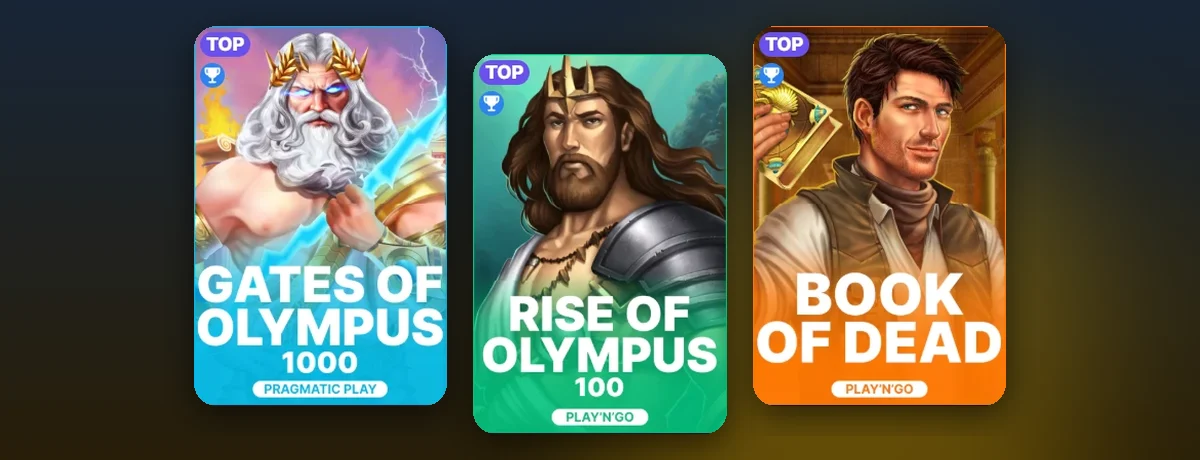
How the dropdown works
For every running Battle, the dropdown shows the titles that count towards the scoring. A click on a game name opens the corresponding game information directly in our games overview. There, the rules, return to player, special features and available stake levels are shown, in other words everything worth knowing before the first tournament round.
In addition, the lobby has its own "Tournament games" area. It shows the same titles, just from the perspective of the games overview. So anyone who wants to start directly from the lobby can find the scored games there with one click.
Why the dropdown matters so much
A game can count in one Battle and not in the next. Some slots appear in several tournaments at the same time, others only in a particular festival. And especially with titles that have similar names or several versions, it is easy to open the wrong variant by mistake.
An example we see quite often: a player launches a well-known slot, is sure they are collecting points, and later wonders why their name does not appear on the leaderboard. The cause is almost always that a different version of the game was being scored. A quick check of the dropdown before starting saves exactly this disappointment.
Reading the game information before starting
We recommend opening the game information for the scored titles once before every Battle. It quickly shows how volatile a slot is, which special features it has and which stake levels are possible. Volatility in particular is interesting for tournaments: a highly volatile title delivers wins less often but sometimes very big ones, while a low-volatility title brings many small hits. Which type suits a particular scoring method better depends on the tournament format. More on that shortly.
How players take part in a Battle
Taking part is deliberately kept simple. Still, a quick look at the process is worthwhile so that no round is lost.
- Open the tournament card: this page and the account list all running Battles with their duration, scored games, points rule and prize distribution.
- Read the rules: the start and end, the minimum stake per scored round and the way points are awarded are particularly important.
- Confirm participation: for Battles with a separate sign-up, participation is confirmed via the button on the tournament card. With other formats, every qualifying round counts automatically.
- Start a scored game: open the right game via the tournament dropdown or the "Tournament games" area in the lobby.
- Check the status: after the first few rounds, take a quick look at the leaderboard to see whether one's own name appears.
The last step is the one many forget. A quick check after the first few rounds that participation has been registered shows immediately if something is wrong, rather than only after a long session.
Checking participation status
Every tournament card shows whether one's own account is taking part in the Battle. In addition, the leaderboard shows the current position and points so far. If one's own name does not appear after several scored rounds, there is usually one of three causes:
- the separate sign-up was not confirmed
- a version of the game that is not being scored was opened
- the stake was below the minimum stake for scored rounds
In all three cases, our live chat can help around the clock. It is quickest with the name of the Battle, the game title and the approximate time of the rounds.
How points are awarded
Every Battle has its own points rule. We use a few basic principles that differ depending on the format. The rule that applies is always shown on the tournament card.
Scoring by win amount
With this principle, the winnings in a round count. Whoever achieves the highest amounts overall or in individual rounds is at the top. This scoring rewards big hits but depends heavily on the stake: a higher stake leads to a higher win for the same result. That is exactly why we view this principle critically for players with a smaller budget and deliberately use it only in certain formats.
Scoring by multiplier
Here, what counts is the ratio between win and stake. A win of €50 on a stake of €0.50 corresponds to a multiplier of 100x, and exactly this value goes onto the leaderboard. The big advantage: the stake plays no role in the placing. A player with a small budget has the same chances as one with a large budget.
We particularly like this principle because it makes the Battles fairer. It is not about who stakes the most but who lands the most spectacular hit. Highly volatile slots are naturally particularly well suited to multiplier Battles, because that is where the really big spikes are possible.
Scoring by number of rounds
In some formats, what counts is simply the number of rounds played or the number of certain events, such as triggered free spins. This scoring rewards stamina more than luck. At the same time, it is the format where we urge the most caution: being scored on the number of rounds creates a particular incentive to keep going. A fixed budget and a fixed time limit are essential here.
Combinations and special rules
Some Battles combine several principles or only count a limited number of the best rounds. One example: only a player's five best multipliers count towards the scoring. Rules like these prevent the sheer number of rounds from deciding everything and make the Battle more attractive for players with little time.
Minimum stake per scored round
Almost every Battle has a minimum stake from which a round counts towards the scoring. Rounds with a lower stake are played and paid out completely normally, but do not count for the leaderboard. The minimum stake is shown on the tournament card and should be compared with one's own stake levels before starting.
Our advice: see the minimum stake as a floor, not a recommendation. Playing at exactly this stake means being fully in. A higher stake brings no advantage in multiplier Battles and, in other formats, often less than expected.
Times, durations and time zone
We give all start and end times of our Battles in German time. That sounds obvious but is more important than it seems. A tournament that ends "at midnight" is only clear if it is known which time zone the time refers to. At EgoGames, it is always the time in Germany, including when the clocks change between summer and winter time.
Each tournament card also has a countdown to the end of the Battle. Rounds started before the end but only completed afterwards are governed by the respective tournament card. Anyone who wants to be on the safe side finishes their last tournament round a few minutes before the close.
Prize pools and prize distribution
Every Battle has a prize pool, stated on the tournament card. This always includes the distribution: how many places receive a prize and how much goes to which place.
How prizes are distributed
The distribution usually follows a sliding scale. First place receives the biggest share, after which the amounts fall place by place. In bigger festivals, significantly more places are often rewarded than in short evening tournaments. Depending on the Battle, prizes come as bonus funds, free spins or real money. The exact form and any wagering are shown on the tournament card.
One point we expressly stress: the advertised total pool is not the amount a single player can win. A pool of €2,000, as in the Shamrock Wins Festival, is spread across several places. Reading the prize scale beforehand makes it clear exactly what taking part can be worthwhile for.
When prizes are credited
After a Battle ends, we check the leaderboard and then credit the prizes. This check is important so that every placing is correct. As a rule, the prizes appear in the account shortly after the check is complete. For prizes in the form of bonus funds, the wagering stated on the tournament card applies.
What happens in a tie
Ties are rarer than many think, but they do happen, especially with scoring by number of rounds. Every tournament card sets out a rule for this case. Often the timing decides: whoever reached the score first is placed ahead. In other formats, the prize for the places concerned is shared. The rule that applies is always fixed before the start, not afterwards.
Thoughts on tactics
We are often asked for the best strategy for our Battles. The honest answer: there is no strategy that guarantees winnings. The results of every single round come about by chance, and a tournament does not change that. What does exist, though, are a few considerations that make the tournament experience more pleasant and more predictable.
Choosing the format to suit the playing style
Not every Battle suits every player. Anyone with little time is better off in a format with a limited number of rounds or multiplier scoring than in a week-long Battle scored on number of rounds. Anyone who likes long sessions will find more room in the weekly leaderboards.
Knowing the volatility
In multiplier Battles, individual big hits often decide things. Highly volatile slots are more likely to deliver such hits, though with long dry spells in between. Anyone who does not like these dry spells should know this beforehand and plan the budget accordingly. In Battles scored by number of rounds, on the other hand, volatility plays hardly any role.
Watching the leaderboard from a distance
A leaderboard is a snapshot. Other players join, results change up to the last minute, and a lead in the afternoon says little about the standings in the evening. We recommend watching the leaderboard calmly rather than checking after every spin. That spares both nerves and budget.
No topping up just before the end
The most important thought concerns the last minutes of a Battle. A place just behind the prize positions creates a strong urge to top up once more. We say it clearly: that is no objective reason to shift one's own budget. The probability of landing exactly the missing hit with an extra deposit is no higher than in any other round.
An evening in a Battle
What a Battle feels like in practice is best described by a completely ordinary evening, as we know it from many of our players.
Shortly after eight, a player opens the tournament page. An evening tournament has been running for an hour, scored by multiplier, with a small minimum stake per round. She sets herself a budget of €30 and an alarm for half past nine. In the tournament dropdown she sees three scored slots, one of which she already knows. One click, the game information opens, a quick check of the volatility, then she starts the first round.
For the first twenty minutes, little happens. A few small wins, nothing that stands out on the leaderboard. Then the free spins trigger, and a hit with a three-figure multiplier pushes her name into the top half of the table. From that moment on, the evening gets exciting: every leaderboard update shows whether other players are catching up.
At half past nine the alarm goes off. She is in a place just outside the prize positions, and her budget is not quite used up. She ends the session anyway. By the end of the Battle she slips two more places, because players who joined late land bigger hits. There is no prize this time, but it was an entertaining evening with a clear framework.
That is exactly how we picture Battles. The competition gives the evening a direction, the budget and the time set the limits, and the result on the leaderboard is a bonus, not the purpose.
Tournaments and normal play compared
What actually changes when a slot is played in a Battle? The short answer: nothing in the game rules, a great deal in the experience.
| Aspect | Normal play | Play in a Battle |
|---|---|---|
| Game rules and return to player | unchanged | unchanged |
| Winnings from rounds | as usual | as usual |
| Additional scoring | none | points according to the tournament rule |
| Leaderboard | none | visible live |
| Additional prizes | none | prize pool for the top places |
| Time frame | open | fixed duration |
The table shows why Battles are so appealing to many players. There is nothing to lose that would not also be at stake in normal play, but there is an extra chance of a prize. At the same time, it explains why a conscious approach matters: the fixed duration and the visible leaderboard create a pressure that does not exist in normal play.
The first tournament attempt
For anyone who has never taken part in a Battle, we recommend a gentle start. A short evening tournament with multiplier scoring is ideal. The stake plays no role in the placing there, the duration is manageable and the end is clearly in sight.
Before starting, it is worth watching the leaderboard for a few minutes. That gives a feel for which scores are needed for the top places and how quickly the table moves. Then start with the minimum stake, check the participation status after the first few rounds and stick to the framework set beforehand.
Anyone who enjoys the Battles after the first attempt can then try weekly leaderboards or a festival. Anyone who notices that tournaments are not for them simply carries on playing as usual. Both are completely fine at EgoGames.
Why Battles only score certain games
A fair question is: why do not all of the over 7,000 games in our lobby simply count for every tournament? The answer has to do with fairness.
Games differ greatly in volatility, maximum win and pace. A slot with a maximum win of 50,000x the stake and a calm title with a maximum win of 500x can hardly be compared sensibly in multiplier scoring. If all games counted, players on extremely volatile titles would have a structural advantage, and the leaderboard would mainly show who picked the wildest game.
With a fixed selection, we create comparable conditions. All participants play on the same titles, with the same rules and the same chances. At the same time, we change the selection regularly so that many different studios and playing styles get their turn over the year. In festivals, the selection also matches the theme, which gives the Battle its own character.
For players this means: before every Battle it is worth checking the tournament dropdown, even if the last Battle ran on similar games. The selection can change from tournament to tournament.
Tournaments and our other offers
At EgoGames, Battles do not stand alone. Rounds in a Battle flow into the weekly cashback as normal, provided they lead to a net loss, and like any other game they contribute to progress in the VIP Club. Credits for the Coin Shop also build up during a Battle as usual. So a Battle is not a separate area but an extra layer on top of normal play that fits seamlessly into our promotions.
Budget and tournaments
Tournaments are entertainment, and entertainment needs a framework. We recommend setting a fixed amount beforehand for every Battle that will be staked at most. Once this amount is reached, participation ends, however close a better placing may seem.
A few rules of thumb that have proven their worth with our players:
- Plan the tournament budget separately: the amount for a Battle is part of the normal entertainment budget, not an extra.
- Set a time limit: decide before starting when the session will end, and set an alarm.
- Use the minimum stake: in most formats, a higher stake brings no real advantage for the placing.
- Forget time already invested: the hours already spent on a Battle create no obligation.
And fundamentally: a Battle does not have to be played. Many players simply follow the leaderboards out of interest without taking part themselves. That too is completely fine at EgoGames.
Tournaments and bonus wagering
A common question concerns how Battles and bonus funds interact. In principle: whether rounds with bonus funds count towards the tournament scoring is governed by the respective tournament card. In some Battles only real money counts, in others bonus funds too.
Conversely, rounds in a Battle count towards bonus wagering as normal, provided the game is eligible for bonus wagering. The "Bonus Wagering" area in the lobby shows which titles these are. Anyone currently wagering a bonus from the welcome package and wanting to take part in a Battle at the same time should therefore check two things: does the game count towards wagering, and do bonus funds count for the tournament? All bonus rules are on our bonus page.
A practical note: tournament prizes in the form of bonus funds have their own wagering. It is stated on the tournament card and applies independently of other active bonuses.
Tournaments on a smartphone
All Battles are fully available on mobile. Via our web app, tournament cards can be opened, the tournament dropdown used, scored games launched and the live leaderboard followed, just as on a computer.
With tournaments in particular, the smartphone has a special advantage: a quick check of the leaderboard is possible on the go. At the same time, we advise reading tournament rules calmly. On a small screen, details such as the minimum stake or the tie rule are easily overlooked. And anyone playing on the move should check the connection before starting, so that no round breaks off in the middle of a tournament.
The most common mistakes in Battles
From many conversations in live chat, we know which mistakes happen most often. Almost all of them can be avoided with a quick check of the tournament card.
- Wrong game version: a variant that is not being scored is launched. Solution: always open games via the tournament dropdown.
- Forgotten sign-up: in Battles with a separate sign-up, no round counts without confirmation. Solution: check the status after the first few rounds.
- Stake too low: rounds below the minimum stake do not count towards the scoring. Solution: compare the minimum stake with the stake level before starting.
- Time zone misjudged: the end is missed. Solution: watch the countdown on the tournament card; all times are in German time.
- Prize pool misunderstood: the total pool is confused with one's own possible prize. Solution: read the prize scale.
- Budget exceeded: topping up just before the end. Solution: set a tournament budget beforehand and stick to it.
Our principles for fair tournaments
So that Battles are enjoyable, EgoGames follows firm principles. The rules of every Battle are fixed before the start and do not change while it runs. The leaderboard is visible to all participants. And before prizes are awarded, we check every placing so that the right players are rewarded in the end.
In the event of irregularities, such as technical faults during a Battle, we decide according to the published tournament rules. Anyone with a question about their own placing can reach our live chat around the clock.
Taking part in tournaments responsibly
Tournaments bring excitement, and that is exactly why they deserve a conscious approach. Anyone who notices that a leaderboard is becoming more important than their own budget should stop taking part and gain some distance. Warning signs include, for example, tournaments becoming a reason for extra deposits or appointments being postponed to follow a Battle to the end.
A self-exclusion can be set up at any time via our live chat. Free and anonymous advice is available from the German gambling addiction helpline run by the BZgA on 0800 1 37 27 00 (Monday to Thursday 10 am to 10 pm, Friday to Sunday 10 am to 6 pm) and on the check-dein-spiel.de platform, with a self-test and counselling programme.
Frequently asked questions about the tournaments
How does participation in an EgoGames Battle work?
The tournament card shows the duration, scored games and points rule. For Battles with a separate sign-up, participation is confirmed via the button on the card; for others, every qualifying round counts automatically. A scored game is then launched via the tournament dropdown.
Which games count in a tournament?
The tournament dropdown on this page lists all scored games for every running Battle. The same titles are in the "Tournament games" area of the lobby. Other versions of a game do not automatically count.
How are points calculated?
That depends on the format. Depending on the Battle, scoring is by win amount, by multiplier, by number of rounds or by a combination of these. In addition, a minimum stake per scored round usually applies. The exact rule is on the tournament card.
When are tournament prizes credited?
After a Battle ends, the leaderboard is checked, and the prizes are then credited. The form and any wagering of a prize are shown on the tournament card.
Do bonus funds count for the tournament scoring?
Each Battle governs this individually. In some tournaments only rounds with real money count, in others rounds with bonus funds too. The details are on the tournament card.
The next Battle starts soon
Whether a short evening tournament, a weekly leaderboard or a themed festival: at EgoGames there is almost always a Battle running. The scored titles can be found in the tournament dropdown and in our games overview, quick rounds for in between under Mini Games. Anyone who also wants to benefit from free spins and reloads can drop by the promotions, and anyone who plays regularly moves up level by level in the VIP Club.
18+ | Gambling can be addictive. Please play responsibly. Help: BZgA helpline 0800 1 37 27 00 and check-dein-spiel.de
